
Anapanasati Sutta: Key Lessons for Breathing
The breath alone provides a complete, stepwise path from calming the body to true insight and freedom.
Mindfulness of breathing, or Ānāpānasati, is a meditation practice that uses your natural breath as a tool to calm the mind and gain deep awareness. It’s based on the Buddha’s teachings in the Ānāpānasati Sutta, which outlines 16 steps divided into four groups: Body, Feelings, Mind, and Mental Qualities. This approach goes beyond simple relaxation, offering a structured path to mental clarity and liberation.
Key Points:
- Focus on the natural rhythm of your breath without controlling it.
- Progress through four stages: observing the body, feelings, mental states, and deeper truths.
- Benefits include reduced stress, improved focus, and insight into impermanence.
Whether you're looking to manage stress or explore deeper meditation, this practice is accessible to anyone, anytime - starting with your next breath. Let’s break it down further.
Mindfulness of Breathing - All 16 Steps | Breath Meditation | Anapanasati | Ajahn Dhammasiha
The 16 Steps Explained
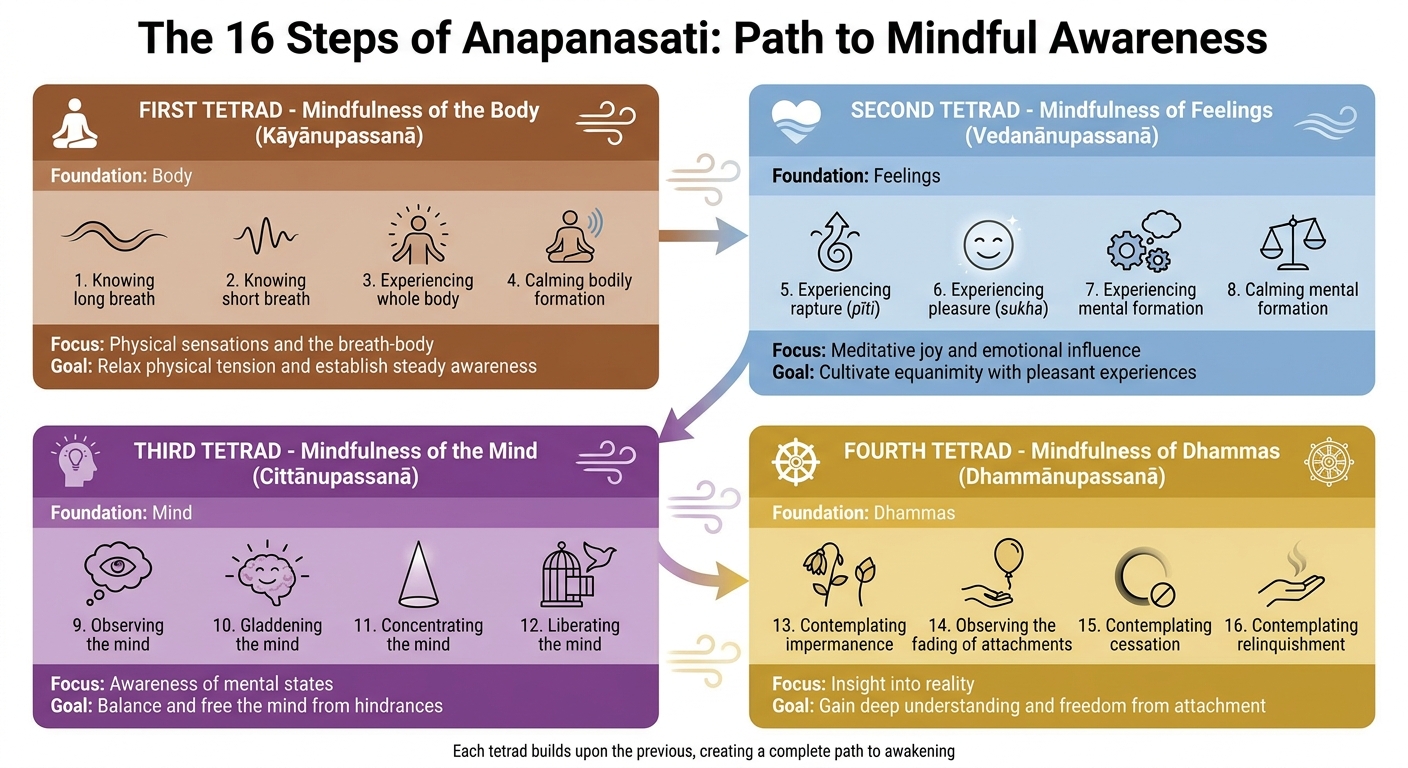
The 16 Steps of Anapanasati Meditation: A Visual Guide to Mindful Breathing
The Ānāpānasati Sutta lays out its meditation practice through 16 steps, grouped into four "tetrads" (sets of four). Each tetrad aligns with one of the Four Foundations of Mindfulness (satipaṭṭhāna): Body, Feelings, Mind, and Dhammas. Let’s break down the focus and progression of each tetrad.
The Four Tetrads Overview
The first tetrad emphasizes Mindfulness of the Body (kāyānupassanā). It starts by observing the breath - whether it’s long or short - and gradually expands to include how breathing affects the entire body. The goal is to relax physical tension and establish a steady, grounded awareness.
The second tetrad shifts to Mindfulness of Feelings (vedanānupassanā). Here, the focus is on experiencing pīti (a vibrant, energetic joy) and sukha (a calmer, more settled pleasure). This phase invites you to notice these feelings without getting carried away by them, ultimately calming the mental formations connected to these emotions.
The third tetrad explores Mindfulness of the Mind (cittānupassanā). This involves observing the state of your mind - whether it feels sluggish, scattered, or clear. The practice here evolves from simply recognizing the mind’s state to actively working with it, such as uplifting a heavy mind or steadying a restless one.
The fourth tetrad focuses on Mindfulness of Dhammas (dhammānupassanā), directing attention to mental qualities and deeper truths. At this stage, the practice transitions into insight (vipassana), contemplating impermanence, the fading of attachments, cessation, and ultimately letting go of clinging. According to the Buddha, completing these 16 steps fulfills the Four Foundations of Mindfulness and cultivates the Seven Factors of Awakening, guiding the practitioner toward liberation.
Below is a summarized breakdown of the 16 steps.
Summary Table of the 16 Steps
| Tetrad | Foundation | Steps | Focus Area | Goal |
|---|---|---|---|---|
| First | Body | 1. Knowing long breath 2. Knowing short breath 3. Experiencing whole body 4. Calming bodily formation |
Physical sensations and the breath-body | Relax physical tension and establish steady awareness |
| Second | Feelings | 5. Experiencing rapture (pīti) 6. Experiencing pleasure (sukha) 7. Experiencing mental formation 8. Calming mental formation |
Meditative joy and emotional influence | Cultivate equanimity with pleasant experiences |
| Third | Mind | 9. Observing the mind 10. Gladdening the mind 11. Concentrating the mind 12. Liberating the mind |
Awareness of mental states | Balance and free the mind from hindrances |
| Fourth | Dhammas | 13. Contemplating impermanence 14. Observing the fading of attachments 15. Contemplating cessation 16. Contemplating relinquishment |
Insight into reality | Gain deep understanding and freedom from attachment |
Understanding Each Tetrad
First Tetrad: Mindfulness of the Body
The first tetrad begins with a straightforward practice: observing whether your breath is long or short. Unlike yogic pranayama, which often involves controlling the breath, Anapanasati focuses on noticing the natural rhythm of your breathing without interference. To maintain concentration, some teachers recommend counting breaths. As Kamalashila explains:
Assessing the length of each breath helps maintain awareness.
Step 3 shifts your attention from a single point, like the nostrils, to a broader awareness of the body. Some interpretations suggest that "whole body" refers to the full duration of the breath, while others see it as encompassing all physical sensations. Step 4 then emphasizes calming bodily formations, which involves relaxing physical tensions and easing the breath. This relaxed state sets the stage for deeper meditative exploration and naturally transitions into observing emotional states.
Second Tetrad: Mindfulness of Feelings
Once the body is grounded, the practice moves into exploring feelings, particularly joy and pleasure. As the body settles, practitioners often experience pīti (rapture) and sukha (pleasure). Pīti can range from subtle sensations, like tingling or goosebumps, to a profound sense of joy throughout the body. A practical tip here is to avoid creating rigid separations between breaths, as this can disrupt these pleasant sensations.
In Steps 7 and 8, the focus shifts to observing these feelings as mental formations that influence the mind's state. Rather than fixating on the content of your thoughts, the practice encourages noticing the experience of thinking itself. Theravada teacher Gil Fronsdal explains:
If we can switch our focus from what we are thinking about (the content) to what it feels like to be thinking (the process), then we can access the ability to relax the 'thinking muscle'.
This shift helps calm mental reactions, fostering a relaxed and non-reactive mental state.
Third Tetrad: Mindfulness of the Mind
The third tetrad focuses directly on observing the mind's current state. Step 9 involves identifying whether the mind is distracted, dull, or clear. If the mind feels sluggish, Step 10 suggests "gladdening" it through uplifting techniques, like reflecting on the Buddha's qualities. Steps 11 and 12 then guide practitioners to steady the mind and free it from hindrances.
This phase is primarily aimed at developing samādhi (concentration). In deep states of concentration, practitioners may experience a meditative sign or nimitta, often described as a luminous point, signaling readiness for jhana (absorption). Teachers advise against chasing this sign, emphasizing the importance of letting it arise naturally. With a focused and liberated mind, the practice transitions into deeper insight in the final tetrad.
Fourth Tetrad: Mindfulness of Dhammas
The fourth tetrad shifts into vipassana or insight meditation. Steps 13–16 guide practitioners to contemplate anicca (impermanence), notice the gradual release of attachments, and practice paṭinissagga, the relinquishment of clinging. This phase represents moving from calming the mind to deeply understanding the nature of reality.
Webu Sayadaw highlights the transformative potential of this stage:
This is a shortcut to Nibbana, anyone can use it. It stands up to investigation and is in accordance with the teachings of the Buddha... It is the straight path to Nibbana.
Applying Anapanasati in Daily Life
Common Mistakes to Avoid
One common mistake when practicing Anapanasati is disrupting the natural rhythm of your breath. Trying to control your breathing or overthinking the process can take away from the practice's simplicity. Another misstep is making the practice overly rigid by relying on strict timers or becoming overly fixated, instead of fostering a broad, whole-body awareness.
Drowsiness is another challenge, often caused by physical fatigue or poor posture. To counteract this, sit upright with a balanced posture and, if necessary, soften your gaze to stay alert. On the other hand, restlessness can be eased by using a simple counting method - counting each breath cycle from 1 to 10 can help anchor your focus.
If your breath becomes so subtle during deep concentration that it feels like it disappears, don’t panic. Instead, gently shift your attention to sensations like the contact between your body and your seat or cushion. Trust that the breath is always there, even if it feels faint.
Breathing Mindfulness Throughout Your Day
Avoiding these common pitfalls allows you to bring the essence of Anapanasati into your daily routine. This practice is like a "portable tool" that helps you cultivate calmness no matter where you are - whether you're waiting in line, sitting on public transit, or transitioning between tasks. By focusing on proper technique, you can weave mindful breathing into your day, creating a sense of stability and presence.
Ajahn Karuniko, a respected Theravada teacher, highlights the purpose of this practice:
"What I see from the way the Buddha taught ānāpānasati: it is using the breath to keep us connected to the experience of the present moment. It is not to get rid of things, but to understand the experience of the present moment."
You can incorporate mindful breathing by taking 3–5 intentional breaths during transitions, such as before starting a new task or during a commute. In moments of stress or heightened emotions, focusing on your breath can provide a much-needed pause, helping you regain clarity.
Another helpful exercise is the 3-Minute Breathing Space. This structured approach involves three steps: spend one minute acknowledging your current thoughts and feelings, one minute focusing on the sensations of your breath, and one minute expanding your awareness to your entire body and surroundings. Additionally, you can bring mindfulness into everyday activities like washing dishes, walking, or working at your computer. This approach blends formal meditation with the flow of daily life.
Benefits from Buddhist Tradition
In traditional Buddhist teachings, Anapanasati is regarded as a complete path to spiritual awakening. It supports the Four Foundations of Mindfulness and the Seven Factors of Enlightenment, fostering both tranquility (samatha) and insight (vipassanā). The Buddha himself emphasized its transformative potential in the Samyutta Nikaya (54.9):
"Just as, bhikkhus, in the last month of the hot season, when a mass of dust and dirt has swirled up, a great rain cloud out of season disperses it and quells it on the spot, so too concentration by mindfulness of breathing... disperses and quells on the spot evil unwholesome states whenever they arise."
These ancient teachings align with modern findings. Regular practice of mindful breathing has been linked to tangible physical benefits, such as a lower resting heart rate, reduced blood pressure, and better heart rate variability - key indicators of improved stress management. Beyond the physical, it also enhances emotional resilience by reducing reactivity to thoughts and feelings while boosting self-awareness. This seamless connection between traditional wisdom and modern mindfulness demonstrates how Anapanasati remains a practical and effective tool for navigating today’s fast-paced world.
Conclusion
The Anapanasati Sutta offers a clear and timeless guide to awakening, rooted in something as simple and accessible as your breath. No tools, rituals, or special environments are required. As the Thalira Research Team aptly states:
"The breath that is happening right now, as you read these words, is the meditation object. You do not need a retreat, a teacher, or special conditions to begin."
At its heart, the practice emphasizes observation over control. Instead of trying to change your breath, Anapanasati encourages you to witness it as it naturally occurs. This practice fosters awareness that begins with the physical sensations of breathing and gradually expands to uncover deeper truths about impermanence and the nature of existence. Through this progression - body, feelings, mind, and dhammas - it nurtures both calm focus and profound understanding.
Modern science increasingly supports these ancient teachings. Studies highlight benefits like improved brain connectivity, reduced emotional reactivity, and better stress management. Whether it’s taking a few mindful breaths before a tense situation or dedicating time to formal meditation, each moment spent with this practice offers a meaningful shift.
What makes Anapanasati especially practical is its accessibility. You can begin anytime, anywhere, simply by observing your next breath. That single moment of mindfulness connects you to a tradition that not only addresses the challenges of modern life but also provides immediate relief from stress. Your breath is always there, a steady anchor to the present and a guide to deeper awareness.
FAQs
Do I need to control my breath?
You don’t need to rigidly control your breathing. Instead, the focus is on simply being aware of your natural breath - observing its gentle flow in and out without trying to change it. This practice encourages a sense of mindfulness and calm.
What if my breath feels like it disappears?
If you notice your breath becoming faint or seemingly disappearing, try gently tuning into the physical sensations of breathing. Even when the breath feels subtle, maintaining mindful awareness of it is an essential part of the practice described in the Anapanasati Sutta. This is a natural occurrence and offers a chance to strengthen your mindfulness.
How do I bring Anapanasati into daily life?
Anapanasati, or mindful breathing, is a simple yet powerful way to bring mindfulness into your daily life. Start by focusing on your breath - notice whether it’s long, short, or somewhere in between. Let your breath become your anchor, helping you tune into your body, emotions, and thoughts.
Over time, expand this awareness to your entire body. You can even check in with your breath during everyday tasks, like walking or waiting in line. With regular practice, this technique can help create a sense of calm and mental clarity, making mindfulness a natural part of your routine.